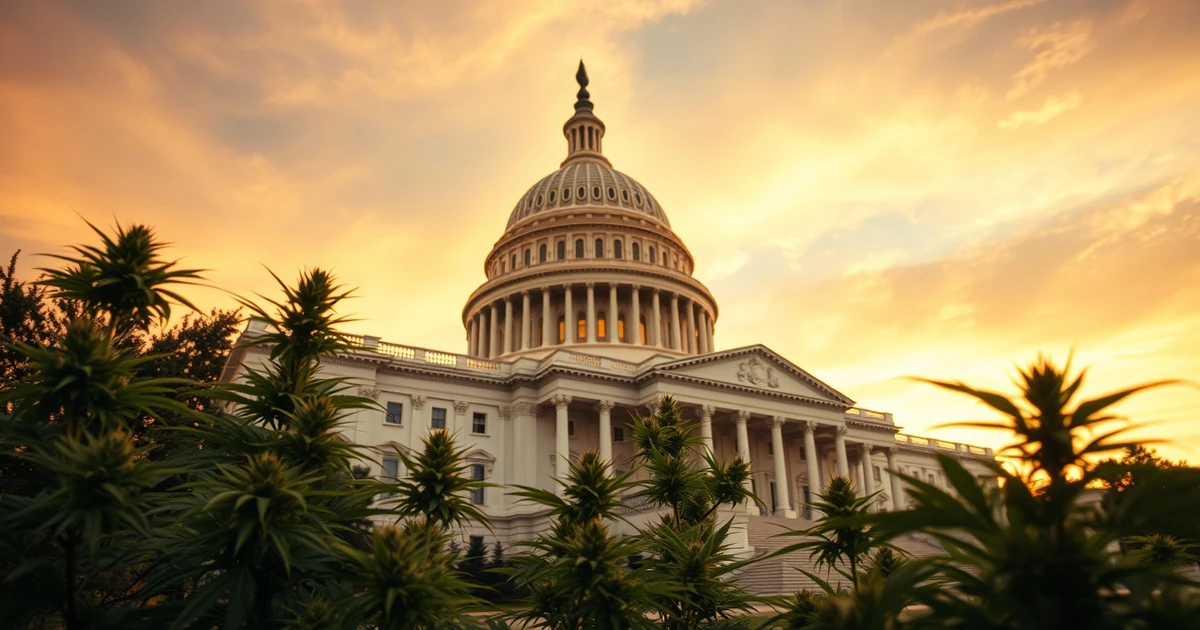
The United States is edging closer to a historic shift in its federal cannabis policy — and the world is watching. In April 2026, two parallel tracks of reform are advancing simultaneously in Washington: an executive rescheduling move under the Trump administration, and a landmark piece of legislation that would remove cannabis from federal scheduling entirely. Together, they represent the most significant momentum in US federal cannabis reform in decades.
The Dual-Track Strategy: Rescheduling vs. Descheduling
For years, US cannabis reform advocates have debated the better path forward: administrative rescheduling through the executive branch, or full legislative descheduling through Congress. In 2026, both tracks appear to be advancing simultaneously — creating an unusual political dynamic.
The Trump administration is reportedly moving forward with an executive order to expedite the reclassification of cannabis from Schedule I to Schedule III under the Controlled Substances Act. Separately, the MORE Act (HR 5068) — the Marijuana Opportunity Reinvestment and Expungement Act — was advancing in the Senate Committee of the Whole as of April 9, 2026. The bill would go far further, fully removing cannabis from the federal controlled substances schedule.
While these two approaches differ substantially in scope and mechanism, their simultaneous movement signals a political environment increasingly receptive to reform — even if the two parties still disagree on how far to go.
What Schedule III Actually Means
It is important to understand what rescheduling to Schedule III would — and would not — achieve. Schedule I classification, under which cannabis has sat since 1970, designates a substance as having "no currently accepted medical cannabis research use" and a high potential for abuse. It has historically blocked clinical research, cut off cannabis businesses from normal banking services, and prevented interstate commerce.
Moving to Schedule III would represent a formal federal acknowledgment that cannabis has accepted medical applications — a significant symbolic and practical shift. Key practical changes would include:
- Research unlocked: Scientists could more easily conduct FDA-approved clinical studies without navigating the current maze of federal restrictions.
- Banking access: Cannabis businesses could begin accessing conventional banking services, addressing a long-standing industry vulnerability.
- Tax reform: The punishing Section 280E of the IRS code — which prevents cannabis companies from deducting normal business expenses — would no longer apply.
However, Schedule III is emphatically not federal cannabis legalization developments globally. Cannabis would remain a controlled substance. Interstate commerce would still be prohibited. State-licensed adult-use cannabis market statisticss would continue to operate in a legal grey zone relative to federal law.

The MORE Act: A Push for Full Descheduling
The MORE Act takes a different approach entirely. If passed, it would remove cannabis from the Controlled Substances Act altogether — a process known as descheduling. This would fundamentally change the legal landscape, allowing regulated interstate commerce, removing federal penalties for adult use, and requiring expungement of certain prior cannabis convictions.
The bill's advancement in the Senate Committee of the Whole as of April 9, 2026 is noteworthy. Previous versions of the MORE Act passed the House but stalled in the Senate. The current political climate appears more favourable for progress, though significant hurdles remain before any floor vote.
For advocates, descheduling is the only acceptable outcome — a symbolic and legal clean break from decades of prohibition. For the industry, it would open the door to national branding, interstate supply chains, and integration with mainstream financial markets.

Cannabis vs. Alcohol: The Market Shift Accelerates
The political momentum for reform is mirrored by striking economic trends. Cannabis sales are rising across regulated markets while alcohol consumption continues a multi-year decline. This shift is increasingly influencing policy conversations in Washington, as lawmakers acknowledge that a growing segment of the population is choosing cannabis over alcohol — a legal, heavily taxed product — yet faces a patchwork of inconsistent state and federal rules.
The U.S. Cannabis Spot Index stood at $1,059 per pound as of April 10, 2026 — a 4.3% increase — reflecting tightening supply and steady consumer demand despite ongoing federal uncertainty. Meanwhile, nearly 50 countries worldwide now have some form of legal cannabis framework, and approximately 230 million people globally are living in adult-use regulated markets.
The contrast is becoming harder for policymakers to ignore: cannabis is increasingly treated as a normal consumer product in much of the developed world, yet in the United States — where the modern cannabis industry was largely pioneered — federal prohibition continues to create structural distortions that disadvantage domestic operators versus international counterparts.

What This Means for EU's contrasting CBD regulations Observers
For readers in Europe, the US federal cannabis debate may seem distant — but its implications are global. The United States remains the world's largest cannabis market, and its regulatory decisions shape international norms, investment flows, and trade policy.
Several European countries are in the midst of their own cannabis liberalisation processes. Germany's evidence-based cannabis reform's phased legalisation framework, Malta and Luxembourg's adult-use reforms, and ongoing policy debates in the Netherlands, Czech Republic, and elsewhere all exist within a global context that the US helps define. If the US moves to Schedule III or full descheduling, it sends a signal to governments worldwide that cannabis prohibition is politically and economically unsustainable.
There are also direct commercial implications. European cannabis companies operating in export-oriented models are watching US federal reform closely, as it could eventually reshape global trade in cannabis genetics, extracts, and finished products. Pharmaceutical-grade cannabis exports from countries like Portugal and Denmark may find new market access opportunities if federal US policy evolves.
For European consumers, US reform also influences product innovation. Many of the vaporizer technologies, consumption formats, and product categories popular in European markets were pioneered in US adult-use states. Greater research freedom and commercial investment in the US would likely accelerate product development across the global industry.
The Road Ahead
Neither rescheduling nor descheduling is guaranteed. Executive orders can be challenged or reversed. Senate floor votes face unpredictable procedural hurdles. The US political landscape in 2026 remains fluid, with midterm cycle dynamics and shifting party positions adding further uncertainty.
What is clear is that the direction of travel has changed. The question in Washington is no longer whether cannabis should be reformed at the federal level, but how — and how quickly. Whether the outcome is the modest but meaningful step of Schedule III, or the bolder leap of full descheduling under the MORE Act, the United States appears to be approaching a turning point in its long and complicated relationship with cannabis.
The global cannabis industry — including the growing European market — will be watching closely.
+Frequently Asked Questions

Written by
The Green Treasure Editorial Team
Independent cannabis journalism backed by science. We cover terpenes, vaporizers, edibles, growing and health.
Stay in the green loop
Expert guides, terpene science, growing tips, and gear reviews — delivered to your inbox. No spam, ever.
No spam. Unsubscribe anytime.