Decarboxylation (decarb) is the single most important step before making any cannabis how long edibles last, tincture, or infusion. Without it, you'll consume THCA — the raw, non-psychoactive acid form — instead of THC. This guide covers every method for decarbing weed at home, with exact temperatures, times, and pro tips to maximize potency.
What Is Decarboxylation?
Raw cannabis contains THCA (tetrahydrocannabinolic acid) and CBDA (cannabidiolic acid) — the acid precursors to THC and CBD. These acid forms don't bind well to the body's endocannabinoid receptors and won't produce psychoactive effects when eaten.
Decarboxylation is the chemical process where heat removes a carboxyl group (COOH) from THCA, converting it to active THC:
THCA Heat → THC CO₂
This happens automatically when you smoke or vape cannabis (instantaneous at combustion/vaporization temperatures). For edibles, you must do it intentionally before infusing into cannabutter, oil, or any other medium.

The Oven Method: Best for Most People
The oven method is the most reliable, accessible, and consistent decarb technique. It requires only a baking sheet and your oven.
Step-by-Step Oven Decarb
- Preheat oven to 110°C (230°F) — fan/convection setting if available
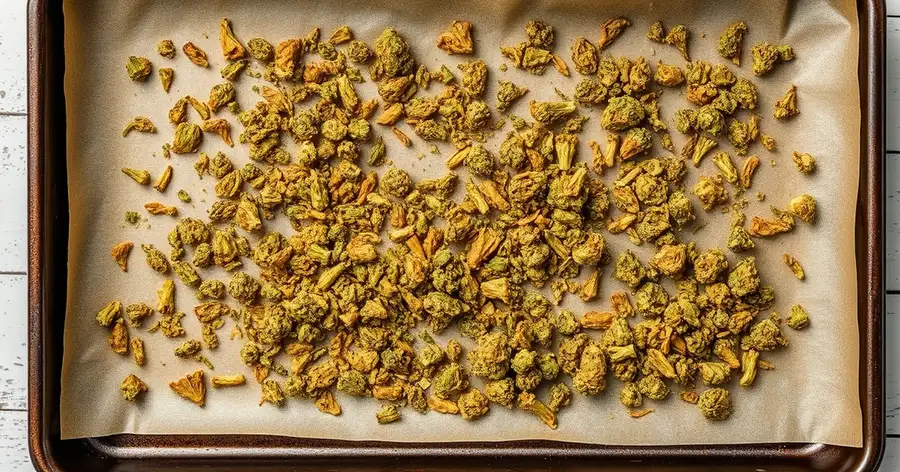
- Break cannabis into small pieces (roughly pea-sized) — don't grind to powder as it can burn
- Spread evenly on a baking sheet lined with parchment paper in a single layer
- Cover loosely with foil to reduce smell (optional, but recommended)
- Bake for 40–45 minutes, turning gently once at the halfway point
- Remove when golden-brown to medium-brown and distinctly herbal-smelling
- Cool completely before using — never rush this step
How to Know It's Done
- Color: Should turn from bright green to golden-brown (light roast coffee color). Not dark brown — that's overdone.
- Texture: Noticeably drier and crunchier than before
- Smell: More pungent and toasted/herbal than fresh cannabis

The Temperature-Time Chart
Different temperatures offer different tradeoffs between THC conversion efficiency and terpene profiles preservation:
| Temperature | Time | THC Conversion | Terpenes | Best For |
|---|---|---|---|---|
| 105°C (220°F) | 60 min | Good (~85%) | Excellent | Terpene-preserving edibles |
| 110°C (230°F) | 40–45 min | Very good (~90%) | Good | Standard edibles (recommended) |
| 120°C (250°F) | 25–30 min | Excellent (~95%) | Moderate | Quick decarb, higher potency |
| 130°C (265°F) | 20 min | High, but some loss | Poor | Not recommended |
The sweet spot is 110°C for 40–45 minutes. Higher temps convert faster but destroy terpenes and eventually start degrading THC into CBN (the sleepy cannabinoid) (the sleepy cannabinoid). Lower temps preserve more terpenes but take longer and may be incomplete.

Alternative Decarb Methods
Mason Jar Method (Smell Reduction)
Breaking cannabis and putting it in a sealed mason jar before placing in the oven dramatically reduces the smell during decarbing. Same temps/times — the jar creates a low-pressure sealed environment.
- Fill a mason jar no more than halfway with ground cannabis
- Seal the lid fingertip-tight (not overly tight — gas needs to escape slowly)
- Place on a folded towel in the oven at 115°C for 60 minutes
- Remove, let cool 30 minutes before opening
Smell is about 70–80% reduced vs. open tray method.
Sous Vide Method (Most Precise)
Sous vide offers the most precise temperature control, minimal smell, and consistent results — ideal for those with a sous vide device.
- Grind cannabis finely and vacuum-seal (or seal in a zip-lock, removing all air)
- Set sous vide to 95°C (203°F)
- Submerge sealed bag, decarb for 90 minutes
- Remove, cool, and use directly
Advantages: Zero smell, precise temp, no burning risk. Disadvantage: Requires equipment, longer time.
Microwave Method (Not Recommended)
Microwaves heat unevenly, making consistent decarboxylation nearly impossible. Some material will burn while other parts remain raw. Avoid for any serious edible production.
Decarbing for CBD (CBDA → CBD)
CBD-rich cannabis (hemp flower, high-CBD strains) decarbs at slightly different temperatures:
| Compound | Optimal Temp | Time |
|---|---|---|
| THCA → THC | 110°C (230°F) | 40–45 min |
| CBDA → CBD | 120°C (248°F) | 40–45 min |
For cannabis that contains both (like many full-spectrum strains), 110–115°C for 45 minutes is a good compromise for both conversions.
Common Decarb Mistakes
Temperature too high: Above 130°C, THC starts degrading into CBN. Your edibles will make you sleepy but won't have full THC potency.
Grinding too fine before decarbing: Powdery material burns at the edges before the interior decarbs. Keep it roughly pea-sized.
Not cooling before using: Hot decarbed cannabis still has some moisture releasing. Let it cool completely before adding to butter or oil — you'll get better infusion.
Skipping altogether: Many first-time edible makers skip decarbing, assuming cooking will do it. While some THCA may convert during cooking, it's inconsistent and incomplete. Always decarb first.
Using a bad thermometer: Many home ovens run 10–15°C hotter or cooler than their dial suggests. An oven thermometer ($10–20) is one of the best investments for consistent edibles.

How to Store Decarbed Cannabis
Properly decarbed cannabis can be stored for later use:
- Airtight container (mason jar) in a cool, dark place
- Room temperature: Up to 3 months
- Refrigerator: Up to 6 months
- Freezer: Up to 1 year
Label with the date, strain, and estimated THC content. Decarbed cannabis looks similar to regular cannabis — always label clearly.
Calculating Potency After Decarbing
If your cannabis is 20% THC:
- 7g × 1,000mg × 0.20 THC = 1,400mg THCA
- After decarb at ~90% efficiency: ~1,260mg active THC
- After infusion at ~65% extraction: ~820mg THC in butter
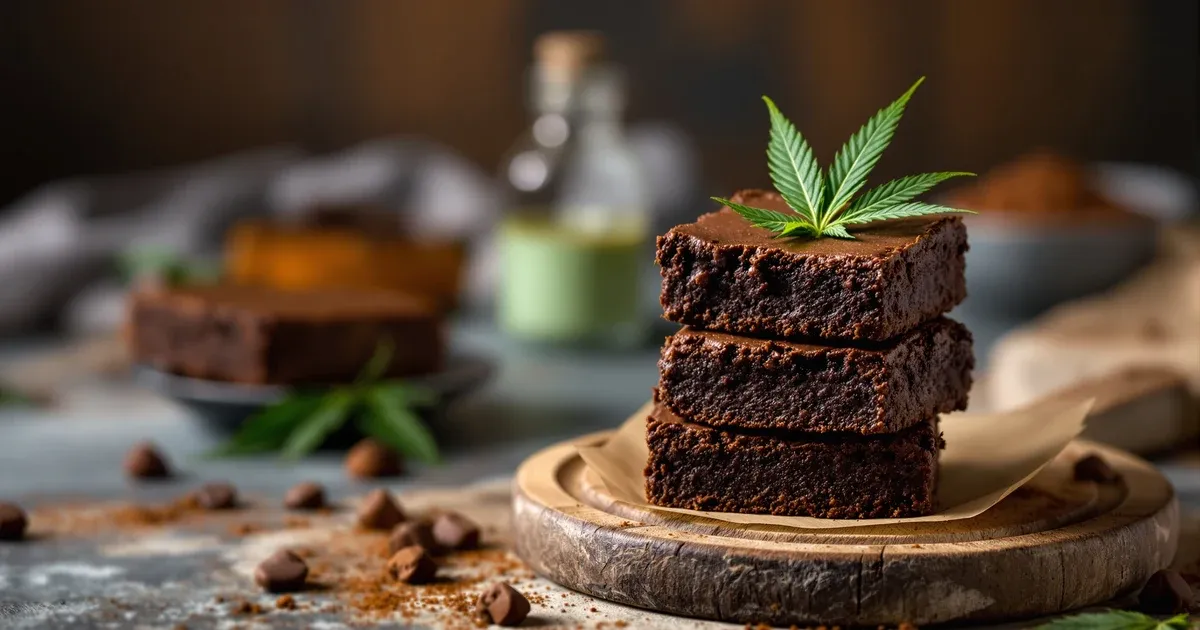
- Divided into 24 weed brownies: ~34mg THC per cookie
Always calculate conservatively. You can always eat more; you can't eat less.
Key Takeaways
- Decarboxylation converts inactive THCA → active THC via heat
- Best method: 110°C oven for 40–45 minutes on a baking sheet
- Target color: golden-brown to medium-brown, never dark
- Mason jar method cuts smell ~70–80%; sous vide is most precise
- Temperatures above 130°C degrade THC into CBN — avoid
- Always let cool completely before infusing into butter or oil
- Calibrate your oven with a separate thermometer
Related Articles
Häufig gestellte Fragen

Geschrieben von
Die Green Treasure Redaktion
Unabhängiger Cannabis-Journalismus auf wissenschaftlicher Basis. Wir berichten über Terpene, Vaporizer, Edibles, Anbau und Gesundheit.