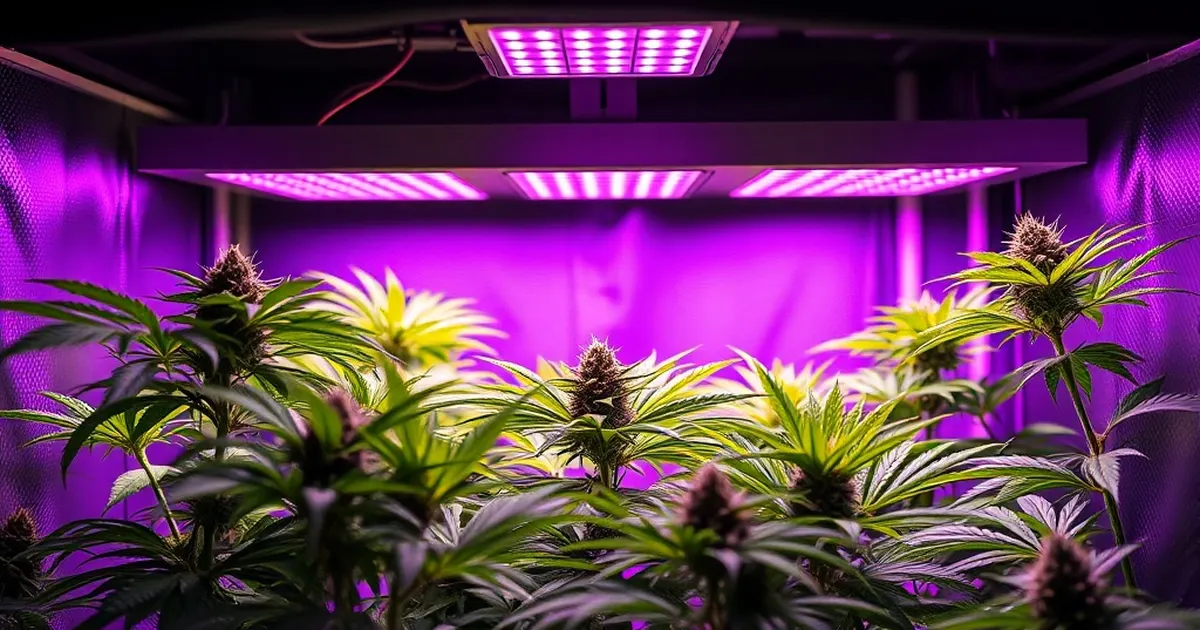
Best Cannabis LED Grow Lights For Indoor Grow Rooms And Tents
The shift to LED grow lights has transformed cannabis cultivation over the past decade. Growers who once battled excessive heat, high electricity bills, and mediocre yields now achieve denser buds with significantly lower operating costs.
This guide covers the best cannabis grow lights led options for every tent size, from compact 2x2 setups to commercial-scale grow rooms. You’ll learn how to evaluate light efficiency, select the right wattage, and maximize your harvest time results.
Intro: LED Grow Light Advantages For Cannabis
Modern led grow lights deliver 2.5 to 3.1 µmol/J efficacy, meaning they convert up to three times more electricity into usable light compared to older technologies. High-pressure sodium (HPS) systems consume 30-50% more power while generating heat that demands aggressive ventilation.
The full spectrum light output from quality LEDs mimics natural sunlight across the 400-700nm PAR range. This balanced spectrum promotes compact growth during veg and resinous flower development during bloom. Grower reports consistently show 20-40% higher cannabinoid yields under optimized LED spectra versus HPS.
For small grow tents, reduced heat output is a game changer. LED fixtures using passive aluminum cooling plates can hang closer to the canopy without causing light burn. This allows growers to maximize limited vertical space while keeping temperature and humidity under control.
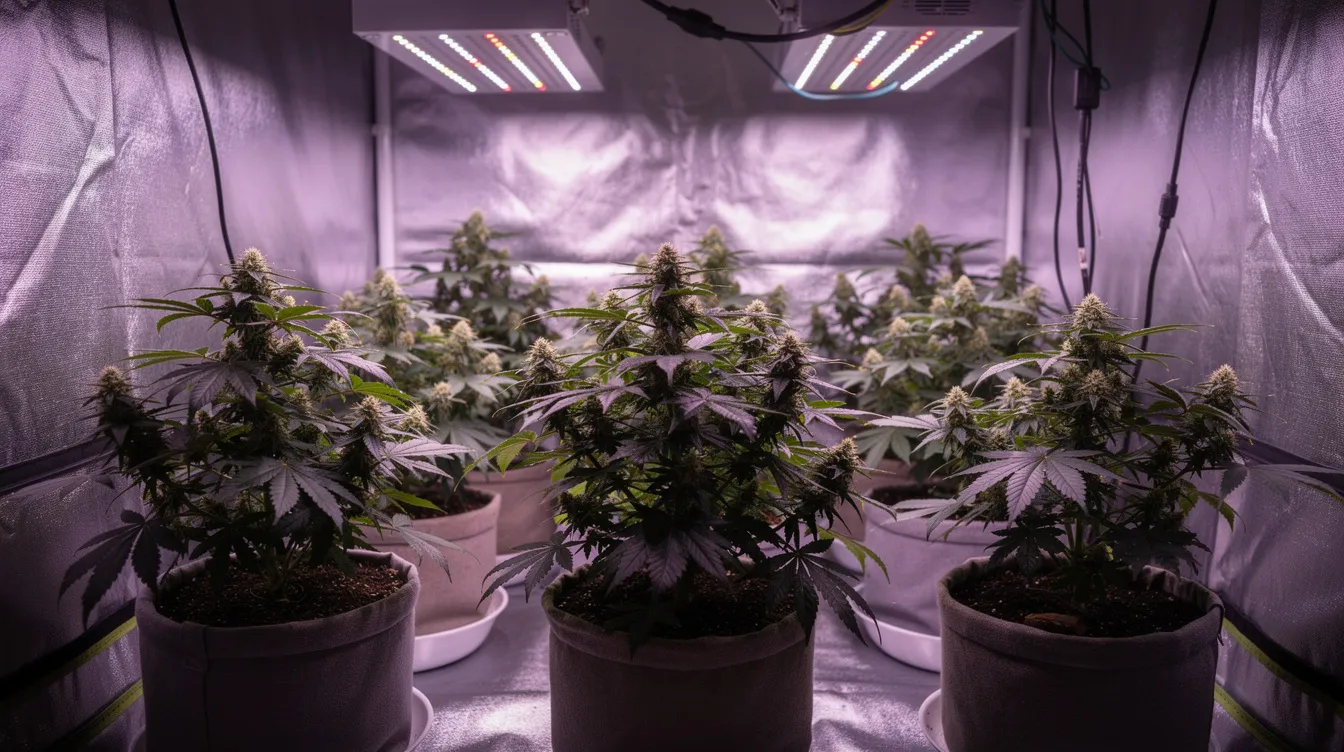
How To Choose The Best Led Grow Lights For Your Grow Space
Selecting the right indoor grow light starts with defining your grow space dimensions and plant goals. Are you optimizing for maximum yields (grams per watt) or potency (THC/CBD through specialized red spectrum)?
When comparing fixtures, scrutinize three key metrics:
PPF (Photosynthetic Photon Flux): Total µmol/s output from the fixture
Efficacy: µmol/J rating showing energy conversion efficiency
PPFD (Photosynthetic Photon Flux Density): Light intensity at canopy level measured in µmol/m²/s
Independent tests reveal some manufacturer claims inflate PPFD by 20-30% due to unfiltered measurements. Verify specs with third-party data from sources like Photone meters.
Size your lighting to tent dimensions: for a 2x2 space, target 150-250W with PPFD of 500-800 µmol/m²/s during veg and 800-1200 during flower. An efficacy rating above 2.7 µmol/J ensures cost-effectiveness over three years.
Check warranty coverage carefully. Top brands offer 3-5 years on diodes and drivers, with Mean Well or Inventronics drivers rated IP65 for humidity resistance. Poor-quality drivers fail at 10-20% input voltage spikes, which are common in home setups.
Key Metrics For High Efficiency And High Intensity Lighting
Calculate usable PPF per watt by dividing total PPF by power draw. A fixture claiming 1890 µmol/s at 750W delivers approximately 2.5 µmol/J, but verify this excludes green/yellow wavelengths that plants use less efficiently.
PPFD maps illustrate light uniformity across your canopy. Ideal cannabis setups demand less than 20% variance from edge to center. Poor uniformity creates stretchy plants at the periphery and potentially stressed plants in hot spots.
Target PPFD ranges by growth stage:
Stage | PPFD Range (µmol/m²/s) | Notes |
|---|---|---|
Seedlings | 200-400 | Dim to 40-60% power |
Veg | 400-600 | Promotes sturdy stems |
Flower | 800-1200 | Maximum terpene production |
Flower CO2 | 1200-1500 | Requires sealed room |
Exceeding 1200 PPFD without CO2 supplementation risks light saturation and bleaching. Bar-style fixtures like the Solux Vega Pro 720W (2.9 µmol/J) excel at delivering 90% uniformity over large areas.

Best Led Grow Lights By Grow Tent And Grow Room Size
The right fixture depends heavily on your cultivation area. Below, you’ll find curated recommendations organized by tent size, with specific wattage targets, expected yields, and airflow considerations.
Selection criteria include:
Efficacy (minimum 2.5 µmol/J recommended)
Canopy coverage uniformity
Price-to-performance ratio
Build quality and driver reliability
Small Grow Tent (2x2 / 0.6m x 0.6m)
For small plant counts in compact spaces, these fixtures deliver excellent quality results without overwhelming your CFM budget:
Mars Hydro TS1000
150W draw, 2.0-2.5 µmol/J
Covers 100x100cm veg, 60x60cm flower
Yield potential: 1.5-2.5g/W
Silent operation, minimal heat
Led TGL Star 60
55W draw, modular design
Suitable for 4 units per square meter
Yield potential: 1.4-1.5g/W
Hang these 18-24 inches above seedlings dimmed to 40-60% power. Target 30-40W per square foot for 1-1.5oz yields per small plant. These silent, low-heat units fit tight spaces without exhausting your ventilation capacity.
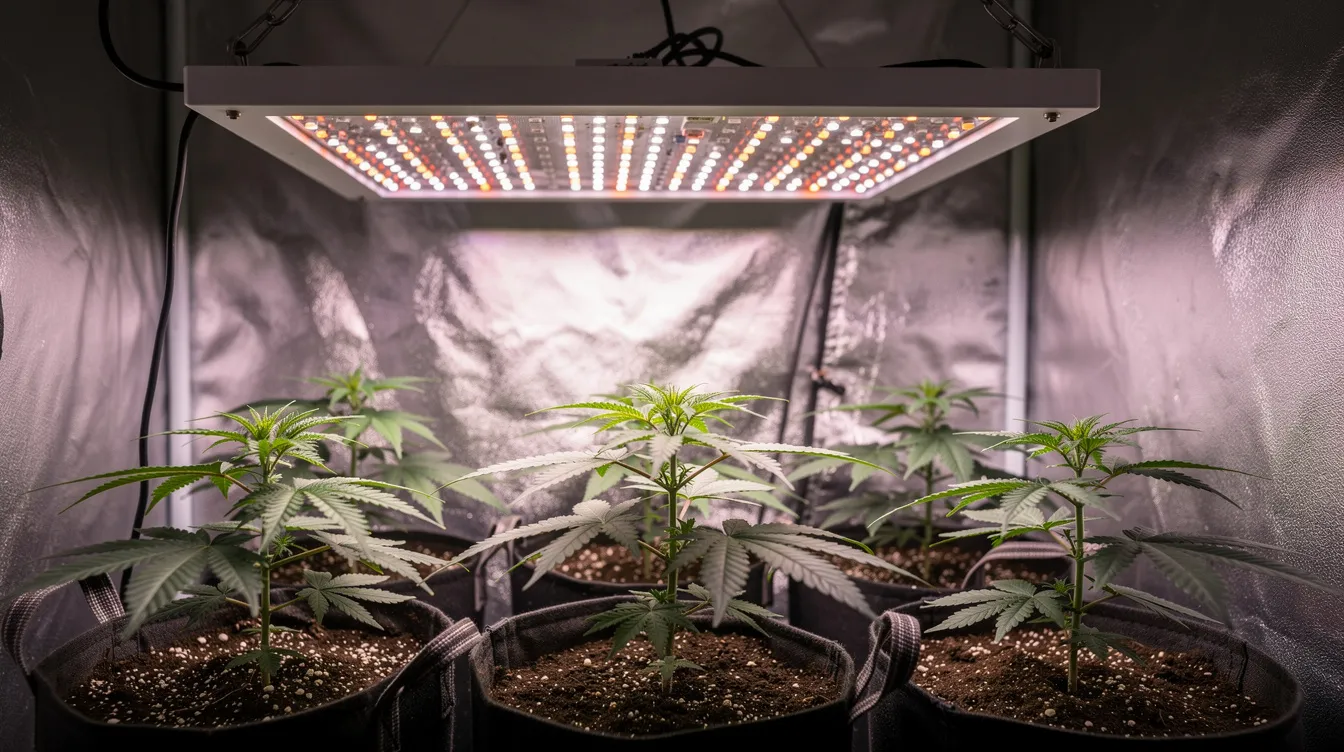
Medium Grow Tent (3x3 to 4x4)
Medium-sized tents (1-1.6m²) benefit from bar-style panels or high-output quantum boards. Total wattage typically ranges from 400-800W for high intensity flowering.
Lumatek Zeus 600W Pro
600W draw, up to 3.1 µmol/J
98% reflective design for 120x120cm coverage
Yield potential: 1.8-2g/W
Passive cooling, 50,000+ hour lifespan
Titan 720W Pro
Homogeneous PPFD distribution
Full-canopy intensity at 40-50W/ft²
Requires 200-400 CFM exhaust
Prioritize models with daisy chain capability for multi-fixture synchronization. SCROG training combined with optimized lighting in this range produces 2-3g/W from experienced growers.
Air circulation becomes critical here. Budget 200-400 CFM exhaust capacity and position oscillating fans at canopy level for 2-5m/s airflow.
Large Grow Tent And Grow Room (5x5+)
Large spaces (2.25m²+) require multiple fixtures arranged for even coverage. Multi-bar arrays minimize shadows and deliver consistent PPFD across the entire canopy.
Top choices for large spaces:
Model | Wattage | Efficacy | Best For |
|---|---|---|---|
Cosmos PRO Elite 720W | 720W | 2.8+ µmol/J | Uniform coverage |
Pure LED Expert 720W | 720W | 2.9 µmol/J | Professional yields |
GB Lighting 720W V3.0 | 720W | 2.7 µmol/J | Adjustable spectrum |
Arrange fixtures in 2x2 grids hung 24-36 inches above canopy with linked drivers. For commercial grows, CO2 supplementation at 1200-1500ppm unlocks PPFD levels above 1500, pushing yields to 2.5g/W or higher.
Sealed rooms running high-intensity lighting need 600+ CFM ventilation to manage 50-60% relative humidity and prevent heat buildup.
Best Led Grow Lights: Top Picks And Use Cases
After testing and comparing specifications, these models consistently deliver reliable results across different cultivation goals:
Best Value: Mars Hydro TS1000
150W, excellent for beginners
Quiet operation, minimal heat
Honest performance at a budget price
Best Yield: Lumatek Zeus 600W Pro
600W, 3.1 µmol/J version available
Passive cooling, no fan noise
Premium driver with surge protection
Best Potency: Solux Kappa 100W
2700K bloom focus
1.8g/W with dense flower production
Suitable for dedicated flowering chambers
Best Intensity: Scorpion Diablo
High PPF output for aggressive grows
Excellent uniformity across 5x5 coverage
Commercial-grade build quality
Best Versatility: GB Lighting 720W V3.0
Fully adjustable spectrum
High uniformity PPFD maps
Supports seed to harvest cultivation
All featured models use Samsung CRI90 diodes or equivalent for build quality, with noise levels under 35dB except fan-cooled units reaching 45dB maximum.
AC Infinity And Smart Indoor Grow Light Options
AC Infinity has emerged as a leader in integrated environmental control. Their IONFRAME series (360W and 480W options) pairs seamlessly with UIS controllers for automated dimming tied to VPD (vapor pressure deficit).
Key benefits of AC Infinity integration:
App-based PPFD adjustments throughout growth stages
Synchronized fan speed and light intensity
Precise 400-1200 µmol/m²/s ramps via automation
Compatible humidity and temperature monitoring
Growers report 15-20% yield improvements when using automated VPD control (targeting 0.8-1.2 kPa). For those seeking a connected home grow experience, AC Infinity fixtures create a reliable ecosystem from seedlings through harvest.
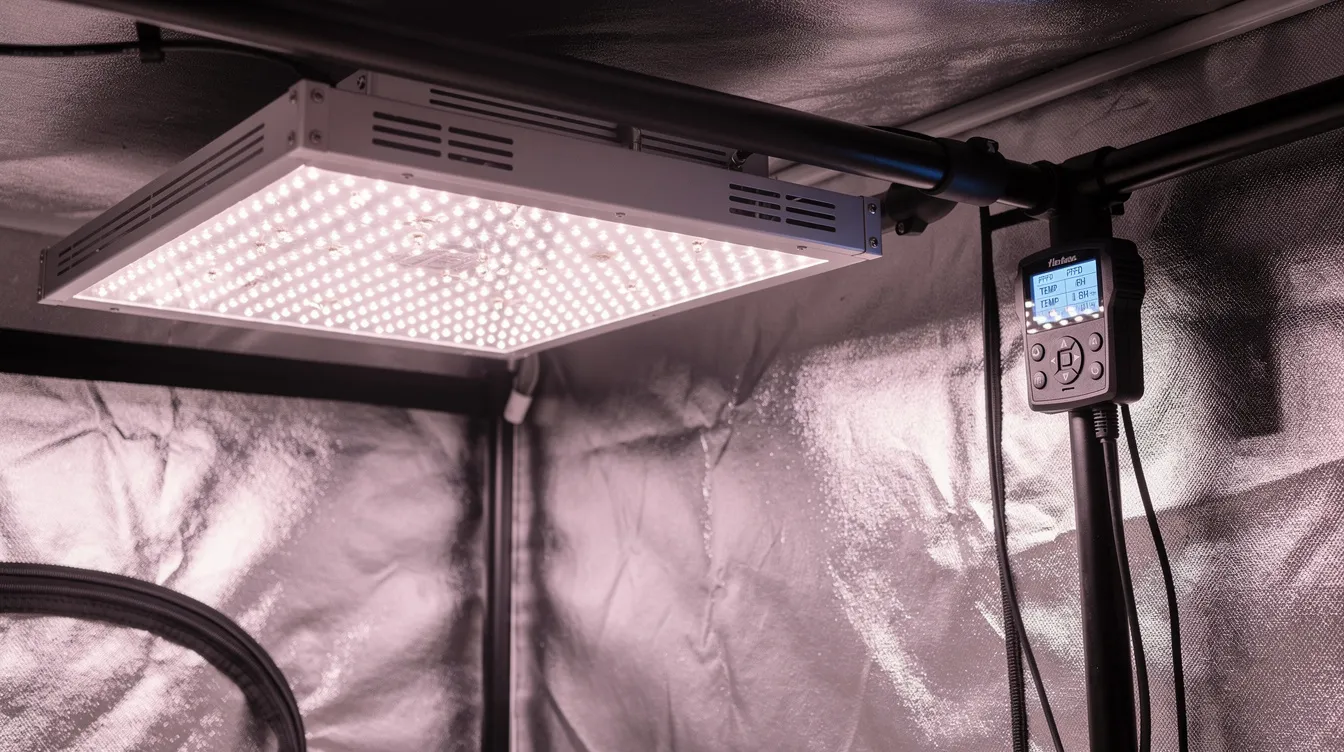
Full Spectrum And Spectrum Tuning For Cannabis
A true full spectrum spans 380-780nm with strategic peaks:
450nm blue: Promotes photomorphogenesis and compact veg growth
660nm deep red: Triggers flowering response
730nm far-red: Encourages shade avoidance for bushier plants
Tunable “R-spec” options amplify 630-680nm wavelengths, with grower trials showing 10-20% THC uplift in certain cultivars. This spectrum focus helps plants grow with increased resin production.
Practical spectrum recipe for all-stage use:
3500K white base
5% 660nm deep red supplementation
Optional UV/IR bars for final flower weeks
This approach avoids the complexity of separate veg and bloom fixtures while promoting healthier plants through consistent light quality.
High Intensity Builds: When To Push Light And Use CO2
Light saturation occurs around 1000-1200 PPFD under ambient CO2 levels (400ppm). Beyond this threshold, plants cannot photosynthesize efficiently regardless of brightness.
CO2 supplementation to 1000-1500ppm raises the saturation point by 30-50%, allowing productive use of 1500+ PPFD. However, cap intensity at 2000 µmol/m²/s to avoid oxidative stress.
Requirements for high-intensity setups:
Sealed grow room or tent
CO2 controller maintaining 1200-1500ppm
Enhanced ventilation (50+ air exchanges per hour)
Active canopy temperature monitoring
Driver rated for continuous full power operation
This level of intensity suits experienced growers in dedicated garden spaces. Beginners should focus on mastering 800-1000 PPFD before scaling up.
Installation, Dimming, Cooling, And Safety
Proper installation protects both your plants and equipment. Plan hanging heights based on growth stage:
Stage | Height (inches) | Dimmer Setting |
|---|---|---|
Clones/Seedlings | 36-48 | 40-50% |
Veg | 18-24 | 60-80% |
Flower | 12-18 | 80-100% |
Use ratchet hangers for easy height adjustment. Position drivers with at least 6 inches of clearance for airflow, as heat buildup reduces lifespan significantly.
Safety essentials:
Surge protectors rated 1000J+ minimum
GFCI outlets in humid environments
Inspect wiring monthly for dust accumulation
Avoid running warm cables near flammable materials
Driver failures account for 10-15% of fixture issues, primarily from power surges. Quality surge protection is cheap insurance against expensive replacements.
Comparing Grow Lights: Testing Method And Charts
Independent testing uses Apogee MQ-500 PAR meters with readings averaged over 9-point grids at 12, 18, and 24-inch hanging heights. This methodology eliminates manufacturer bias and reflects real-world performance.
Cost-per-usable-PPF comparison (3-year calculation):
Model | Efficacy | Cost/µmol/year | 3-Year Electricity |
|---|---|---|---|
Lumatek Zeus 600W | 2.8 µmol/J | $0.02 | $450 |
Mars Hydro TS1000 | 2.3 µmol/J | $0.03 | $220 |
HPS 600W | 1.7 µmol/J | $0.05 | $680 |
Factor 25,000-hour L90 depreciation (90% output retention) when calculating long-term value. The best led grow lights maintain brightness across multiple grow cycles.
Uniformity testing for TS1000 shows 85% coverage at 700 PPFD center to 500 PPFD at edges, acceptable for 2x2 tents but highlighting the need for bright center placement.
Optimize Grow Tent Layout And Airflow
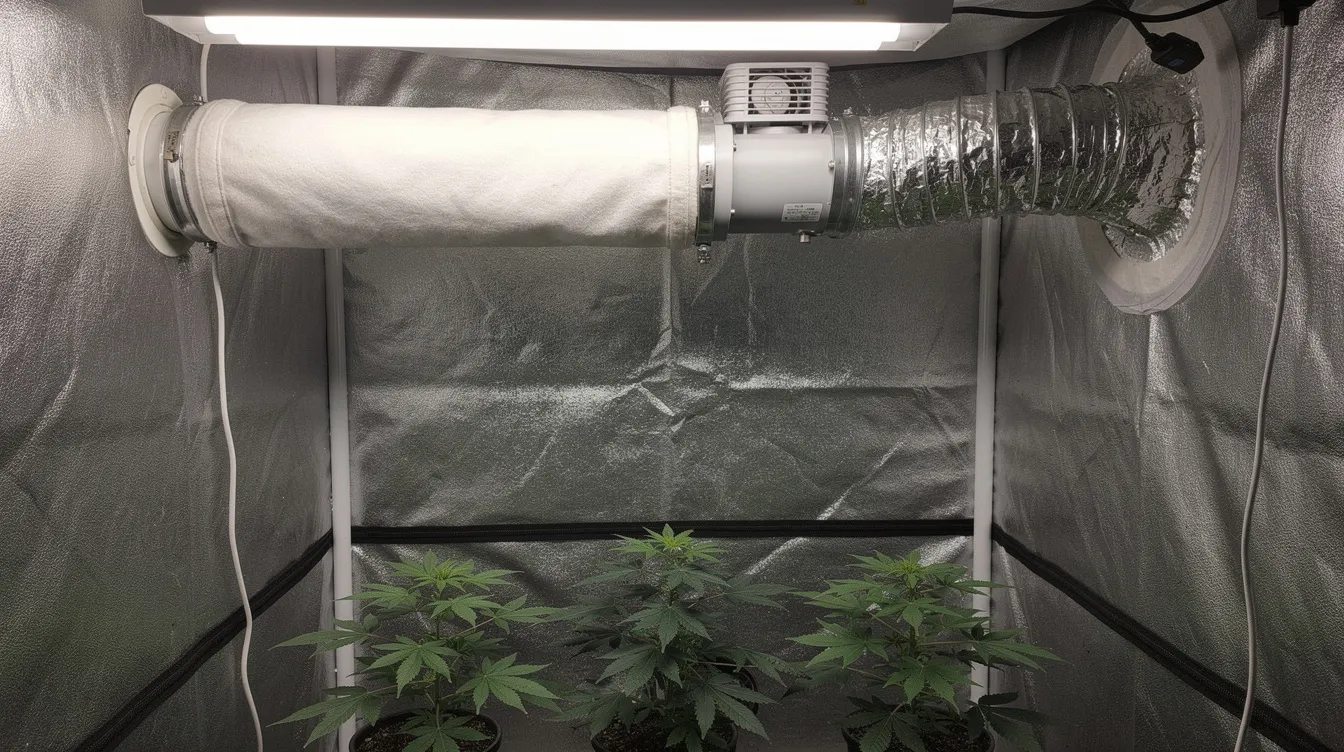
Proper air circulation maximizes light efficiency by strengthening stems and regulating temperature at the canopy.
Recommended fan placement:
6-inch inline fan (400CFM) positioned low for intake
8-inch exhaust fan mounted high
Oscillating clip fans at canopy level for 2-5m/s airflow
Carbon filters post-exhaust for 99% odor control
Vertical training techniques like LST (low-stress training) or SCROG nets expose 90% of bud sites to direct light. Combined with uniform PPFD, this can lift yields 30-50% without additional wattage.
Position your lamp centrally, adjusting tent layout to create unobstructed airflow paths from intake to exhaust.
Buyer Checklist: Features For The Best Led Grow Lights
Before purchasing, verify these specifications:
Efficiency and Output
[ ] Efficacy rated above 2.7 µmol/J
[ ] Verified usable PPF (third-party tested preferred)
[ ] PPFD maps showing less than 20% edge variance
Spectrum and Control
[ ] Full spectrum or tunable spectrum options
[ ] 0-100% dimming capability
[ ] Daisy chain support for multiple fixtures
Build and Fit
[ ] Driver rated IP65 for humidity resistance
[ ] Fixture dimensions fit intended tent
[ ] Warranty covering 3+ years on diodes and driver
Practical Considerations
[ ] Noise level acceptable (under 40dB for living spaces)
[ ] Price aligns with efficacy and coverage area
[ ] Replacement parts availability from led grow lights depot or manufacturer
FAQ: Common Questions About Cannabis Grow Lights
How many watts per square foot do I need?
Target 30-50W per square foot as a baseline, scaling to 60W/ft² when supplementing with CO2. A 4x4 tent (16 sq ft) performs well with 480-800W of efficient LED lighting.
What’s the difference between PAR and lumens?
PAR measures photons in the 400-700nm range that plants actually use for photosynthesis. Lumens measure light intensity weighted for human vision, which overvalues green wavelengths that plants use less efficiently. Always prioritize PAR ratings over lumens for cannabis.
When should I add supplemental side lighting?
Side lighting benefits dense canopies after closure, typically mid-to-late flower. Adding 300 PPFD to lower bud sites can increase yields 10-20% in vertical grows. For most home grow setups with proper training, overhead lighting suffices.
Do LEDs work for herbs and vegetables too?
Absolutely. The same full spectrum principles apply to herbs, greenhouse vegetables, and ornamental plants. Adjust intensity and photoperiod according to each species’ needs.
How long do quality LED fixtures last?
Expect 50,000+ hours to L90 (90% original brightness) from fixtures using Samsung or Osram diodes. At 12 hours daily operation, that translates to 10+ years of effective use.
Conclusion: Recommend Fixtures For Tents And Grow Rooms
Choosing the best led grow lights comes down to matching fixture output to your space and goals. Here’s the honest breakdown by tent size:
Tent Size | Top Pick | Why |
|---|---|---|
2x2 | Mars Hydro TS1000 | Best value, beginner-friendly |
3x3 to 4x4 | Lumatek Zeus 600W Pro | Excellent yields, energy efficient |
5x5+ | Spider Farmer or multi-bar array | Scalable, uniform coverage |
For those prioritizing automation, AC Infinity’s integrated systems deliver control that helps plants thrive with minimal manual intervention.
Single best pick for beginners: The Mars Hydro TS1000 offers tested performance, reasonable price, and forgiving operation that lets new growers focus on learning cultivation fundamentals rather than fighting their equipment.
Whatever you choose, prioritize efficacy above 2.5 µmol/J, verify PPFD claims with independent data, and size your fixture to your space. With the right light and proper environment, you’ll achieve dense, potent harvests cycle after cycle.
Related Articles
Frequently Asked Questions

Written by
The Green Treasure Editorial Team
Independent cannabis journalism backed by science. We cover terpenes, vaporizers, edibles, growing and health.
Stay in the green loop
Expert guides, terpene science, growing tips, and gear reviews — delivered to your inbox. No spam, ever.
No spam. Unsubscribe anytime.